
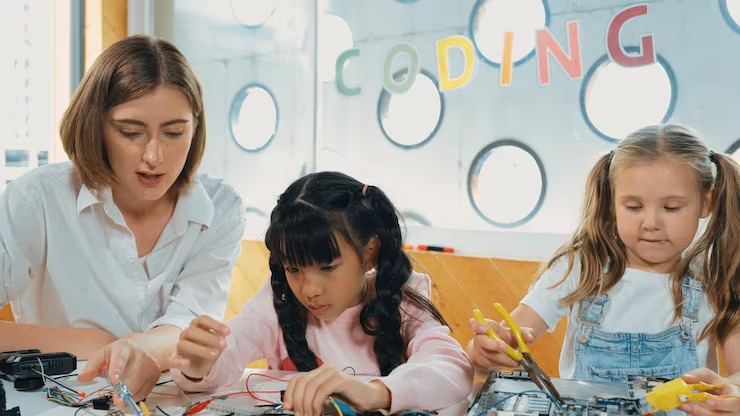
If you had to choose one quality to develop in a young child above all others, what would it be? Intelligence? Creativity? Resilience? Educators who study early childhood development would likely say: the ability to think through unfamiliar problems with patience and curiosity. That quality, more than any specific knowledge, determines long-term success. And it is precisely what Experiential learning for kids is designed to build.
SunStart was created with a clear conviction: children should not just receive information. They should build understanding through experience. The difference between those two approaches is the difference between a child who knows a fact and a child who genuinely comprehends the world around them.
The Science Behind Experiential Learning for Kids
Why Experiential Learning for Kids Produces Lasting Understanding
Educational researchers have long noted that knowledge acquired through active experience is retained far more effectively than knowledge acquired through passive instruction. This is because experiential learning creates episodic memory, the kind associated with personal experience, alongside semantic memory, the kind associated with facts and concepts.
When a child builds a three-dimensional shape, compares its properties to a two-dimensional version, and then describes the difference in their own words, they are creating a rich, multi-layered memory of that concept. SunStart structures every learning activity to create exactly this kind of layered memory through the cycle of exploration, physical interaction, and guided expression.
How Hands-On Learning Develops Both Mind and Character
Hands-on learning is often discussed primarily in terms of cognitive outcomes. But the character development that comes through experiential learning is equally significant. When children work through a physical challenge, make mistakes, adjust their approach, and eventually discover a solution, they develop resilience. When they share their discoveries with a parent or teacher, they develop communication skills and the confidence to express their thinking.
SunStart explicitly names these character outcomes as part of its educational mission. The program is designed not only to develop mathematical skill but to build creativity, adaptability, focus, persistence, and the kind of confidence that comes from genuine achievement rather than external praise.
Five Pillars of the SunStart Experiential Learning System
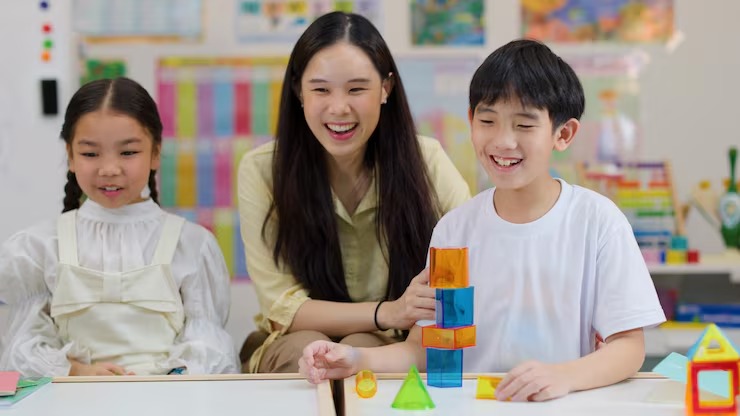
How Experiential Learning for Kids Is Structured at SunStart
SunStart’s learning system is built on five integrated components that work together to create a complete experiential learning environment.
Digital courseware provides animations, audio guidance, visual prompts, and game-based activities that make concepts accessible and engaging while providing immediate feedback that guides further exploration.
Hands-on teaching aids give children physical tools to build, sort, compare, and explore, making abstract ideas concrete and visible through touch and movement.
Full-color workbooks provide structured spaces for recording discoveries, expressing observations, and reflecting on the learning process in ways that consolidate understanding.
Story-based contexts embed every concept in a narrative that gives children emotional and imaginative connection to the mathematical ideas they are exploring.
Guided parent-child discussion transforms scattered individual observations into organized logical thinking through questions and shared conversation.
What Experiential Learning for Kids Looks Like Day to Day
- A child explores a digital lesson featuring animated shapes and receives instant feedback
- They then build physical versions of those shapes with teaching aids
- They record their observations and discoveries in a colorful workbook
- A parent asks guiding questions that help the child connect physical experience to mathematical language
- The child expresses their understanding in their own words, consolidating the learning cycle
This daily pattern, repeated across hundreds of activities over the course of the program, builds a deeply ingrained habit of thoughtful, curious, reflective learning.
The Developmental Case for Starting Early
Why Experiential Learning for Kids Should Begin by Age Three
The brain’s plasticity is at its peak during the early years. Neural connections form rapidly, cognitive habits are established, and attitudes toward learning solidify. Children who experience learning as active, joyful, and rewarding during these years are far more likely to carry that relationship with learning forward.
SunStart’s curriculum begins at age three precisely because this is the optimal window for establishing the thinking habits and learning confidence that will serve children throughout their education. Every year that passes without rich experiential learning is a year of opportunity that cannot be fully recovered.
Conclusion
Experiential learning for kids is not a nice-to-have educational luxury. It is a fundamental approach to developing the kind of thinkers the world needs. SunStart’s integrated system combines digital interaction, physical exploration, reflective workbooks, and guided conversation into a complete learning experience that produces deep understanding, genuine confidence, and the character qualities that define lifelong learners.
Frequently Asked Questions
Q1: How does experiential learning at SunStart differ from traditional classroom instruction? Traditional instruction typically delivers information and then asks children to practice it. SunStart reverses this order: children explore first and arrive at understanding through guided discovery, producing far deeper and more durable learning outcomes.
Q2: What age is ideal for starting experiential learning programs? SunStart recommends beginning at age three. This captures the developmental window when curiosity-driven exploration has the greatest impact on building cognitive habits and mathematical foundations.
Q3: How can I tell if experiential learning is working for my child? Watch for changes in how your child approaches challenges at home. Children engaged in effective experiential learning begin to slow down, observe carefully, try different approaches, and describe their thinking rather than guessing quickly and moving on.