
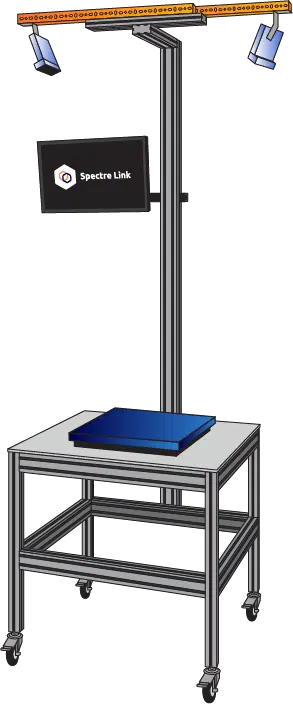
Ask any dock supervisor what slows the day down, and measuring freight will come up fast. It looks like a small job. But when forty pallets are waiting and the trucks are lined up outside, those few minutes per load add up to a real problem. A pallet dimensioner takes that job off your workers’ hands and gives you accurate numbers in seconds.
Keeping the Dock Moving
Think about how measuring usually goes. A forklift driver stops, climbs down, and pulls out a tape measure. Then comes the walk around the pallet, a note on paper, and a climb back up. Someone types those numbers into the system later, and a few of them get typed wrong.
A pallet dimensioner replaces all of that. The forklift drives in, the system scans, and the driver moves on. Nobody leaves the seat and nobody holds up the lane behind them.
No More Traffic Jams at Peak Hours
Manual measuring is at its worst when you are busiest. One slow pallet blocks the one behind it, and soon the whole dock is backed up. That is also when accidents happen, because people rush and forklifts crowd into tight spaces.
Automated scanners fix this by measuring the load right where it sits, whether that is on the forklift or on a floor scale. Goods go from the receiving bay to the outbound trailer without stopping for paperwork.
Faster, Cleaner Data
A good system captures length, width, height, weight, and a photo of the load, all in a few seconds. The data goes straight into your shipping software. No logbooks, no re-typing, no guessing at someone’s handwriting.
Billing benefits most. Once the truck picks up the freight, the invoice can go out with correct numbers already attached.
Filling Trailers the Right Way
Wasted trailer space is expensive, and most of it comes from poor estimates. Guess too low and you leave empty room you paid for. Guess too high and the carrier may reject the load or charge you a penalty.
When you know the exact size of every pallet, load planning gets much easier. You can see which loads fit together before anything goes on the truck.
What accurate dimension data lets you do
- Scan outbound loads before you plan the trailer, so you work from real numbers.
- Group pallets of compatible shapes into the same trailer.
- Cut down on empty space by planning around actual volume.
- Avoid rejections by matching true weight and size to carrier limits.
- Use fewer trips, which means less fuel burned across your routes.
Saving Money by Getting It Right
Carriers charge dimensional weight adjustments when your declared size does not match what they measure. These charges often arrive weeks later, which makes them hard to budget for and annoying to dispute.
A pallet dimensioner records the true dimensions at the moment of shipping, along with a photo. If a carrier challenges a charge, you have proof. Over a year, avoiding even a few of those backcharges makes a noticeable difference to your margins.
Why Cloud Access Matters
Many modern dimensioners connect to a cloud portal. Your team can check volume data, machine status, and photos from a phone or laptop without walking down to the dock.
For anyone managing more than one site, this is a big help. Dock data stops being a pile of numbers and starts helping with decisions about inventory, scheduling, and staffing.
What a cloud-connected system gives you
- Live visibility into dock activity across all your facilities.
- Photo proof that settles damage claims and carrier disputes quickly.
- Software updates and maintenance handled remotely, without waiting for a technician.
- A direct link to your warehouse management system, so billing updates happen on their own.
Conclusion
Measuring freight by hand made sense when there was no alternative. Now there is one. A pallet dimensioner cuts out the tape measures, shortens loading times, and gives you billing data you can trust. If your dock is slowing down at the busiest hours, this is one of the simpler fixes worth looking at.
Frequently Asked Questions
Can a dimensioner work with my existing warehouse management system?
In most cases, yes. Modern cloud-based systems are built to connect with WMS platforms, so freight records, inventory tracking, and carrier billing update without anyone entering data by hand.
How does accurate measuring help avoid carrier backcharges?
When the exact size is recorded before the freight leaves, the carrier has less room to reclassify the shipment. That means fewer surprise re-weigh fees and dimensional weight surcharges.